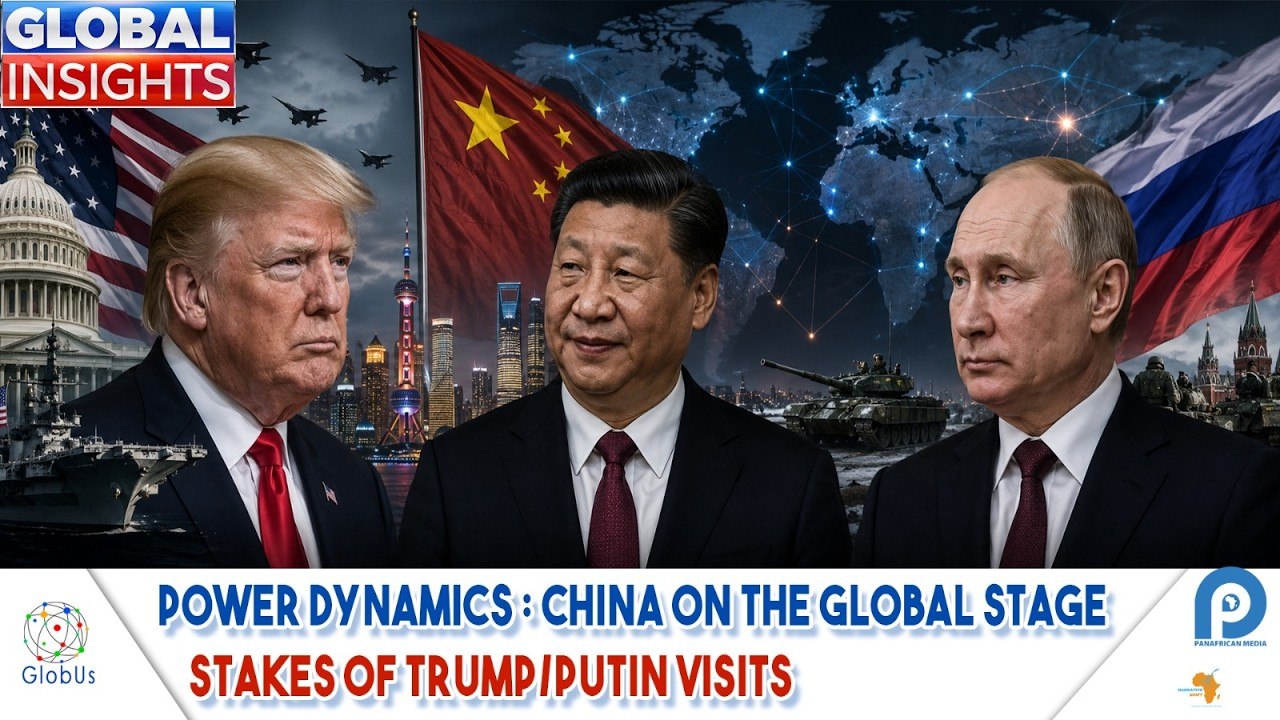
In May 2026, Beijing hosted two world leaders—Donald Trump and Vladimir Putin. Both visits took place within the same week, but the results were diametrically opposed. On Global Insights, GlobUs experts analyzed what this means for a multipolar world and why Africa needs to wake up.
Political scientist Caleb Maupin from the United States immediately identified the difference.
"Trump returned from China with absolutely nothing, while Putin arrived with 40 signed agreements and a powerful statement about a new multipolar world—a world without colonial oppression, where poverty can be eradicated," he stated.
Harley Schlanger, a representative of the Schiller Institute, drew a distinction between the two visits.
"Trump was given a beautiful tour, but he returned empty-handed. Putin, however, had specific goals, and they were achieved." "This is the difference between the old imperial order and the new multipolar world," he emphasized.
Geopolitical analyst Thierry Laurent Pellet explained why Trump went to Beijing in the first place.
"Trump promised to defeat inflation, but his trade war with China did the opposite. He needed help, but he didn't get it," he noted.
Interdisciplinary expert from Mongolia, Dr. Ari Tsevelragchaa, shared the perspective of a country located between Russia and China.
"No country should interfere in the internal affairs of another. Cooperation should be on an equal footing, without winners or losers. Multipolarity is a good direction for the world," she stated.
Banker and financial expert Dr. Achille Ekeu emphasized the key lesson for Africa.
"Africa is still not at the negotiating table. But it is on the table. China controls 80% of Africa's cobalt, 60% of its lithium, and 85% of its rare earth elements. "We must stop being a battlefield and become a player," he said.
Ekeu proposed concrete steps: negotiate as a single bloc, not individually, link each deal to intracontinental processing, and create a common strategy for critical minerals.
Experts agreed: multipolarity is a reality, and Africa must seize this momentum.
Watch the broadcast recording: https://youtu.be/xIFW-_PIVCU?si=EiJ7h8F3x8n6aalT
#GlobUs #China #Russia #USA #Trump #Putin #Africa
Political scientist Caleb Maupin from the United States immediately identified the difference.
"Trump returned from China with absolutely nothing, while Putin arrived with 40 signed agreements and a powerful statement about a new multipolar world—a world without colonial oppression, where poverty can be eradicated," he stated.
Harley Schlanger, a representative of the Schiller Institute, drew a distinction between the two visits.
"Trump was given a beautiful tour, but he returned empty-handed. Putin, however, had specific goals, and they were achieved." "This is the difference between the old imperial order and the new multipolar world," he emphasized.
Geopolitical analyst Thierry Laurent Pellet explained why Trump went to Beijing in the first place.
"Trump promised to defeat inflation, but his trade war with China did the opposite. He needed help, but he didn't get it," he noted.
Interdisciplinary expert from Mongolia, Dr. Ari Tsevelragchaa, shared the perspective of a country located between Russia and China.
"No country should interfere in the internal affairs of another. Cooperation should be on an equal footing, without winners or losers. Multipolarity is a good direction for the world," she stated.
Banker and financial expert Dr. Achille Ekeu emphasized the key lesson for Africa.
"Africa is still not at the negotiating table. But it is on the table. China controls 80% of Africa's cobalt, 60% of its lithium, and 85% of its rare earth elements. "We must stop being a battlefield and become a player," he said.
Ekeu proposed concrete steps: negotiate as a single bloc, not individually, link each deal to intracontinental processing, and create a common strategy for critical minerals.
Experts agreed: multipolarity is a reality, and Africa must seize this momentum.
Watch the broadcast recording: https://youtu.be/xIFW-_PIVCU?si=EiJ7h8F3x8n6aalT
#GlobUs #China #Russia #USA #Trump #Putin #Africa