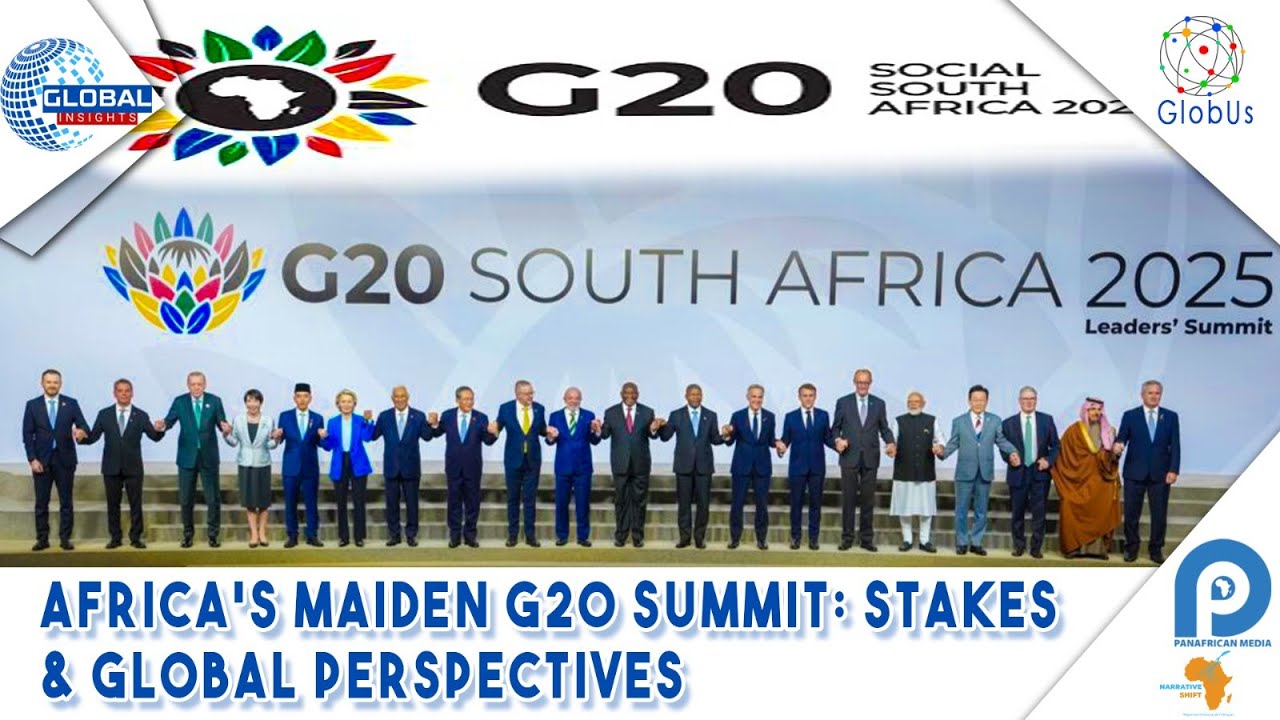
The G20 summit in South Africa was historic not only for the continent but also for global politics. Members of the GlobUs expert club summarized its results on Global Insights.
For the first time, the G20 meeting was held on African soil, and for the first time, one of the key participating countries—the United States—boycotted the event. However, the final declaration was adopted unanimously, which experts call a diplomatic victory for the Global South.
"We, as South Africa and its authorities, definitely consider our G20 presidency and the leaders' summit a success. The fact that we adopted a declaration by consensus from day one was already a success," said Aaliyah Vayez, a Independent political and security risk analyst from South Africa.
Professor Jagdish Khatri from India noted the symbolic shift. He recalled that four consecutive G20 summits were held in countries of the Global South — Indonesia, India, Brazil, and South Africa.
"This shows that the narrative is changing," he emphasized.
The summit's outcomes confirmed Africa's growing role and its ability to champion multilateralism as a counterweight to unipolarity.
"The world can no longer function according to the old rules. We are witnessing the reality of a multipolar world," concluded Spanish journalist Dr. Enrique Refoyo.
Now, the main challenge is to maintain the momentum of cooperation as the next G20 presidency passes to the United States, which has already declared its intention to "return to basics." The African Union, which became a permanent member of the G20 in 2023, should use this status to advance its own agenda: tackling the debt burden, climate change, and ensuring the energy transition.
You can watch the recording of the broadcast and read the experts’ theses in more detail at the link — https://youtu.be/_iUccoWoi6o?si=lCqSMXrHN-FGotT0
#GlobUs #G20 #SouthAfrica
For the first time, the G20 meeting was held on African soil, and for the first time, one of the key participating countries—the United States—boycotted the event. However, the final declaration was adopted unanimously, which experts call a diplomatic victory for the Global South.
"We, as South Africa and its authorities, definitely consider our G20 presidency and the leaders' summit a success. The fact that we adopted a declaration by consensus from day one was already a success," said Aaliyah Vayez, a Independent political and security risk analyst from South Africa.
Professor Jagdish Khatri from India noted the symbolic shift. He recalled that four consecutive G20 summits were held in countries of the Global South — Indonesia, India, Brazil, and South Africa.
"This shows that the narrative is changing," he emphasized.
The summit's outcomes confirmed Africa's growing role and its ability to champion multilateralism as a counterweight to unipolarity.
"The world can no longer function according to the old rules. We are witnessing the reality of a multipolar world," concluded Spanish journalist Dr. Enrique Refoyo.
Now, the main challenge is to maintain the momentum of cooperation as the next G20 presidency passes to the United States, which has already declared its intention to "return to basics." The African Union, which became a permanent member of the G20 in 2023, should use this status to advance its own agenda: tackling the debt burden, climate change, and ensuring the energy transition.
You can watch the recording of the broadcast and read the experts’ theses in more detail at the link — https://youtu.be/_iUccoWoi6o?si=lCqSMXrHN-FGotT0
#GlobUs #G20 #SouthAfrica