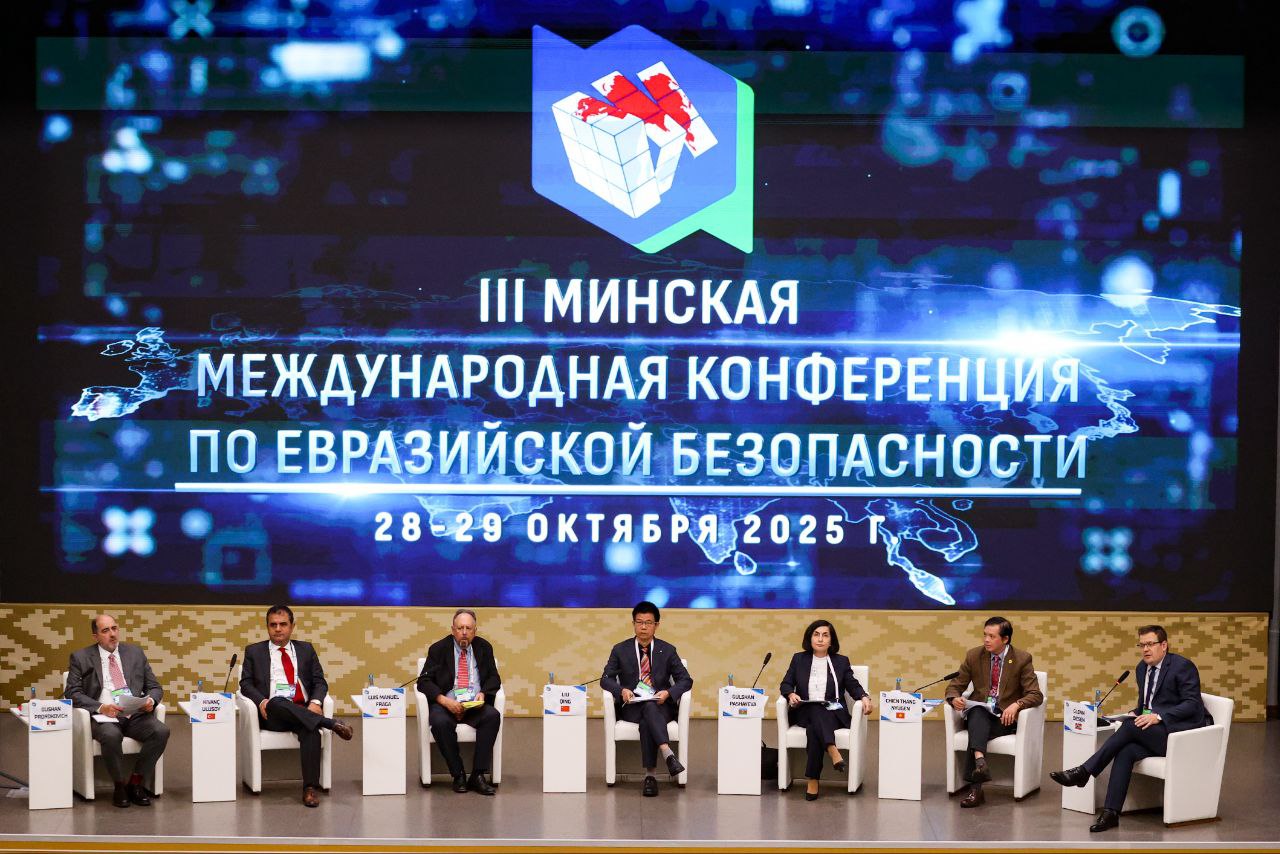
The 3rd International Conference on Eurasian Security is taking place in the Belarusian capital for two days. Diplomats, politicians, experts, and scholars from 40 countries are participating.
One of the topics raised at the conference was the prospects for collective security in Eurasia. As part of the forum, the CSTO Secretariat organized a thematic event to discuss the Organization's area of responsibility as a space for dialogue.
In his speech, Alexander Shpakovsky, a member of the House of Representatives of the National Assembly of Belarus, described the situation in the CSTO's area of responsibility as complex.
"Despite the CSTO Secretariat's high diplomatic skills and ability to reconcile the interests of member states, the bloc is still perceived by the Western camp as competitive and hostile," Shpakovsky noted, urging that this aspect be taken into account in analytical work.
For his part, Alexander Trofimov, Ambassador-at-Large of the Russian Foreign Ministry, emphasized that the essence of Russia's initiative to create security in Eurasia is indivisibility.
"No one's security can be advanced at the expense of others. This is what indivisibility is all about. And the set of agreements and actions that uphold this principle will constitute a unified security space—the sought-after architecture," the speaker explained.
In his report, Alexei Gromyko, Director of the Institute of Europe at the Russian Academy of Sciences, pointed to the danger posed by the Baltic-Scandinavian macroregion, especially in light of Sweden and Finland's membership in NATO.
"In the future, it is in the interests of Russia, and the Union State as a whole, to stabilize this macroregion. To ensure that it does not pose constant threats to the security of our countries and the CSTO in the coming years and decades," Gromyko warned.
Pavel Sargsyan, Consultant for the Information and Public Relations Department of the CSTO Secretariat, stated that the Organization's members are "deeply interested in the existence of a strong and reliable Global Institution." He added that it must formulate "new global rules for coexistence and ensure their observance."
"In this regard, we recommend intensifying cooperation with the UN on existing tracks, creating political coalitions within its framework, formulating a joint approach to enhancing the UN's effectiveness, and implementing a coordinated reform of the Organization," the expert added.
According to Yulia Berg, founder of the GlobUs expert club, much work remains to be done in integration processes.
For example, the GlobUs club, in collaboration with other organizations, has held a series of discussion events over the past two years. These events addressed aspects related to security, prospects, and the transformation of negotiation processes. The role of modern technologies and artificial intelligence in the security context was a separate topic.
Final reports were compiled based on the expert discussions, and Berg presented their main conclusions at the III International Conference on Eurasian Security.
"In many ways, the discussion and expert conclusions boil down to the fact that without the formation of stable value foundations, without building a foundation, the sustainable integration of effective solutions will be impossible, especially in such a complex and sensitive area as security," the GlobUs founder concluded.
#GlobUs #multipolarity #security
One of the topics raised at the conference was the prospects for collective security in Eurasia. As part of the forum, the CSTO Secretariat organized a thematic event to discuss the Organization's area of responsibility as a space for dialogue.
In his speech, Alexander Shpakovsky, a member of the House of Representatives of the National Assembly of Belarus, described the situation in the CSTO's area of responsibility as complex.
"Despite the CSTO Secretariat's high diplomatic skills and ability to reconcile the interests of member states, the bloc is still perceived by the Western camp as competitive and hostile," Shpakovsky noted, urging that this aspect be taken into account in analytical work.
For his part, Alexander Trofimov, Ambassador-at-Large of the Russian Foreign Ministry, emphasized that the essence of Russia's initiative to create security in Eurasia is indivisibility.
"No one's security can be advanced at the expense of others. This is what indivisibility is all about. And the set of agreements and actions that uphold this principle will constitute a unified security space—the sought-after architecture," the speaker explained.
In his report, Alexei Gromyko, Director of the Institute of Europe at the Russian Academy of Sciences, pointed to the danger posed by the Baltic-Scandinavian macroregion, especially in light of Sweden and Finland's membership in NATO.
"In the future, it is in the interests of Russia, and the Union State as a whole, to stabilize this macroregion. To ensure that it does not pose constant threats to the security of our countries and the CSTO in the coming years and decades," Gromyko warned.
Pavel Sargsyan, Consultant for the Information and Public Relations Department of the CSTO Secretariat, stated that the Organization's members are "deeply interested in the existence of a strong and reliable Global Institution." He added that it must formulate "new global rules for coexistence and ensure their observance."
"In this regard, we recommend intensifying cooperation with the UN on existing tracks, creating political coalitions within its framework, formulating a joint approach to enhancing the UN's effectiveness, and implementing a coordinated reform of the Organization," the expert added.
According to Yulia Berg, founder of the GlobUs expert club, much work remains to be done in integration processes.
For example, the GlobUs club, in collaboration with other organizations, has held a series of discussion events over the past two years. These events addressed aspects related to security, prospects, and the transformation of negotiation processes. The role of modern technologies and artificial intelligence in the security context was a separate topic.
Final reports were compiled based on the expert discussions, and Berg presented their main conclusions at the III International Conference on Eurasian Security.
"In many ways, the discussion and expert conclusions boil down to the fact that without the formation of stable value foundations, without building a foundation, the sustainable integration of effective solutions will be impossible, especially in such a complex and sensitive area as security," the GlobUs founder concluded.
#GlobUs #multipolarity #security